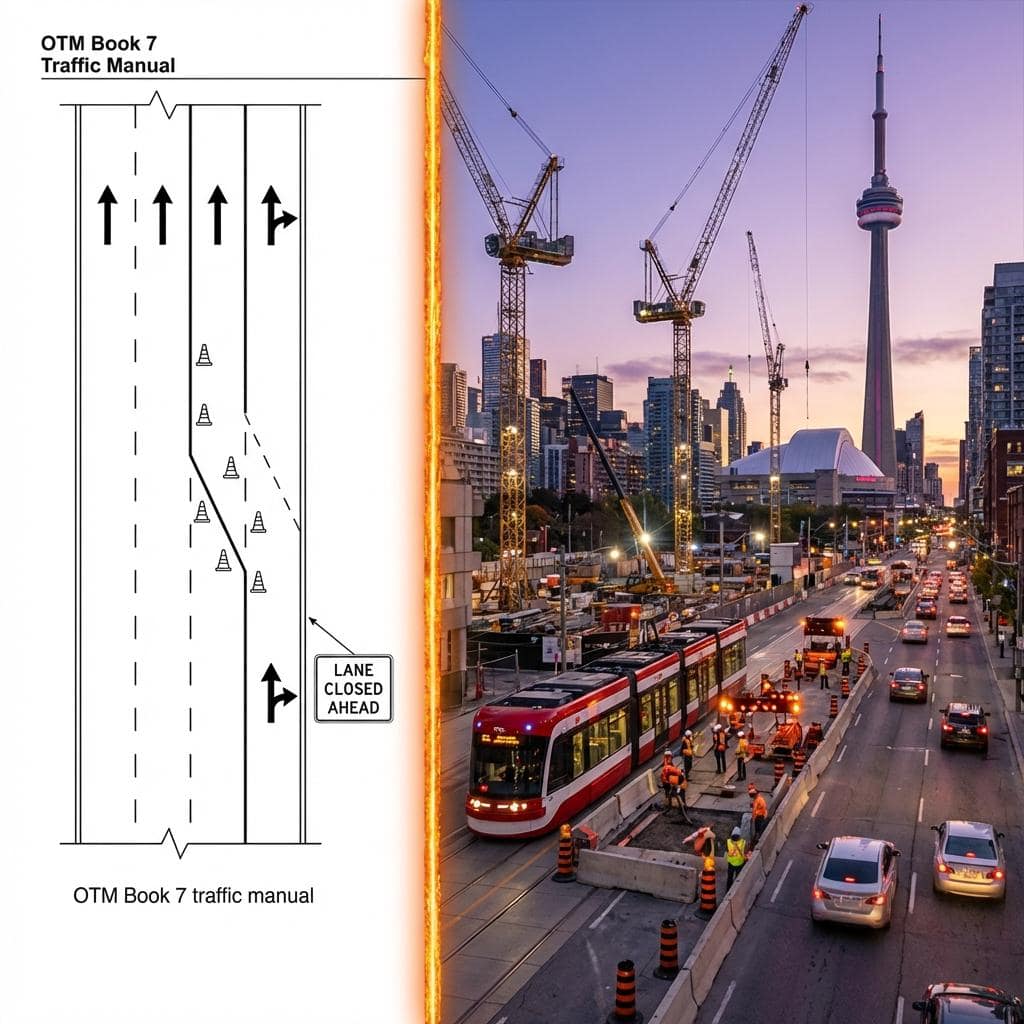
The ‘Book 7’ Paradox Explained
In Toronto traffic control, following the bare minimum legal requirements often creates the maximum amount of friction, slowing down projects and sometimes even making them less safe. OTM Book 7 is the “bible” for temporary traffic conditions in Ontario, but its generic diagrams are no match for Toronto’s unique density. With over 220 active cranes, a complex streetcar network, and dedicated bike lanes, standard plans simply fail. A plan can be legally compliant yet wildly inefficient, causing traffic backups, late material deliveries, and costly crew downtime.
The High Cost of ‘Just Enough’ Compliance
Many contractors treat traffic control as a “checkbox” item, which proves expensive. A generic plan creates a clunky transition from live traffic to the work zone, leading to what we call “traffic turbulence.” This bottlenecks equipment entry and exit; losing just 10 minutes per dump truck can amount to over three hours of lost production time across 20 trucks. This idle time for specialized crews, which can cost thousands per hour, inflates project costs significantly. Furthermore, a generic plan that leads to an accident can still trigger a Ministry of Labour investigation, proving that “legal” isn’t always safe.
Strategy #1: Transition from ‘Standard’ to ‘Site-Specific’ Engineering
“Typical” diagrams with vague measurements are the enemy of efficiency in a city where every meter counts. Site-specific plans use CAD to map exact locations, accounting for the 1.8m pedestrian mandate, utility poles, TTC routes, and vehicle turning radii. Pre-job site audits identify “Timeline Killers”—like traffic surges from nearby schools—allowing for proactive adjustments. A mid-rise developer in the West End saw a 15% increase in daily work hours after a custom plan improved traffic flow and cut delivery delays.
Strategy #2: Leverage Attenuator Trucks (TMAs) for Rapid Setup
Truck Mounted Attenuators (TMAs) provide essential “positive protection” on high-volume GTA roads. The “Speed to Safety” metric is key: while a manual lane closure can take up to an hour, a TMA acts as a “mobile shield,” driving into position in minutes. This can reduce setup and tear-down time by up to 30%. The psychological impact of these “big trucks” is also significant; their flashing arrow boards and crash cushions calm driver behavior, reducing rubbernecking and aggression for smoother, faster traffic flow around your site.
Strategy #3: Proactive Flagging and ‘Traffic Intelligence’
Professional flaggers are “Traffic Managers,” not just “Sign Holders.” Using radios for constant communication, they monitor both traffic and site activities to create a “Flow State” site. In what we call the “Concrete Sync,” our teams coordinate with concrete pours and crane lifts, creating gaps for mixer trucks and preventing wasted “hook time.” This level of “Traffic Intelligence,” which includes specialized training for Toronto’s unique challenges like streetcars and pedestrian crowds, is what keeps your timeline intact.
The Hidden ROI of Professional Traffic Control
It’s a counter-intuitive truth: investing more in high-quality traffic control provides an incredible Return on Investment (ROI). The math is simple: an extra $500 per day for a site-specific plan and TMA that saves one hour of crew idle time (costing $2,000/hour) yields a 400% ROI. This doesn’t even account for avoiding massive city fines, liquidated damages, or brand damage. “Cheap” traffic control is always the most expensive option.
Conclusion: Book 7 is the Floor, Not the Ceiling
For the GTA construction market, you must go beyond minimum compliance. Reclaiming your construction schedule requires site-specific engineering, leveraging the right tools like attenuator trucks, and investing in the intelligence of professional flagging services. When you review your next traffic plan, ask yourself: is it built for compliance, or is it built for speed? If the answer is compliance, you are losing weeks off your timeline.